Gradient-based optimization of a cross-resonance gate between two transmons
import itertools

import matplotlib.pyplot as plt
import numpy as np

from paraqeet.measurement.unitary_fidelity import UnitaryFidelity
from paraqeet.model.closed_system import ClosedSystem
from paraqeet.model.composite_hamiltonian import CompositeHamiltonian
from paraqeet.model.coupling import TwoBodyCoupling
from paraqeet.model.drive_operator import DriveOperator
from paraqeet.model.transmon import Transmon
from paraqeet.optimization_map import OptimizationMap
from paraqeet.optimizers.scipy_optimizer_gradient import ScipyOptimizerGradient
from paraqeet.propagation.propagation import Propagation
from paraqeet.propagation.scipy_expm_goat import ScipyExpmGOAT
from paraqeet.quantity import Quantity
from paraqeet.signal.envelopes import FlatTopGaussianEnvelope
from paraqeet.signal.iq_mixer import IQMixer

np.set_printoptions(linewidth=400)
System Setup
The sytem consists of two coupled transmons with three levels each. We fix the transmon frequency and anharmonicity to values that don’t have any unwanted frequency collisions. The coupling strength is fixed as well. These parameters have to be specified as Quantites with a range, but we will not pass them to the optimized in order to keep them fixed. Additionally, the first transmon is driven at the frequency of the second one to apply a cross-resonance (CR) gate. The second transmon is driven to fix the phases of the gate.
Here the tone values are set such that the optimization process is fast.
Generally with a lot of parameters ScipyExpmGOAT (in its current
form), can take considerably long time.
t_final = 150e-9
tone1 = FlatTopGaussianEnvelope(
    amplitude=Quantity(
        190e6 * 2 * np.pi, min_value=1e5 * 2 * np.pi, max_value=250e6 * 2 * np.pi, name="Amp", unit="Hz", two_pi=True
    ),
    t_final=Quantity(
        t_final,
        min_value=10e-9,
        max_value=200e-9,
        unit="s",
        name="Gate time",
    ),
)

tone2 = FlatTopGaussianEnvelope(
    amplitude=Quantity(
        9.18e6 * 2 * np.pi,
        min_value=1e5 * 2 * np.pi,
        max_value=250e6 * 2 * np.pi,
        name="Amp",
        unit="Hz",
        two_pi=True,
    ),
    t_final=Quantity(
        t_final,
        min_value=10e-9,
        max_value=200e-9,
        unit="s",
        name="Gate time",
    ),
)


tone2.t_final = Quantity(
    t_final,
    min_value=10e-9,
    max_value=200e-9,
    unit="s",
    name="Gate time",
)

print(tone1.get_parameters(), tone2.get_parameters())
generator1 = IQMixer(
    envelopes=[tone1],
    frequency=Quantity(
        6.0002e9 * 2 * np.pi,
        min_value=5.5e9 * 2 * np.pi,
        max_value=6.20e9 * 2 * np.pi,
        name="Freq",
        unit="Hz",
        two_pi=True,
    ),
)
drive1 = DriveOperator(generator1, is_longitudinal=False)

generator2 = IQMixer(
    envelopes=[tone2],
    frequency=Quantity(
        6.0002e9 * 2 * np.pi,
        min_value=5.5e9 * 2 * np.pi,
        max_value=6.20e9 * 2 * np.pi,
        name="Freq",
        unit="Hz",
        two_pi=True,
    ),
    phase=Quantity(
        value=-0.39720756,
        min_value=-np.pi,
        max_value=np.pi,
        unit="rad",
        name="Phase",
    ),
)

drive2 = DriveOperator(generator2, is_longitudinal=False)

transmon1 = Transmon(
    dimension=3,
    frequency=Quantity(
        5.5e9 * 2 * np.pi,
        5.2e9 * 2 * np.pi,
        5.9e9 * 2 * np.pi,
        "Hz",
        "Transmon 1 frequency",
        two_pi=True,
    ),
    anharmonicity=Quantity(
        -240e6 * 2 * np.pi,
        -250e6 * 2 * np.pi,
        -190e6 * 2 * np.pi,
        "Hz",
        "Transmon 1 anharmonicity",
        two_pi=True,
    ),
    drives=[drive1],
)
transmon2 = Transmon(
    dimension=3,
    frequency=Quantity(
        6.0e9 * 2 * np.pi,
        5.9e9 * 2 * np.pi,
        6.1e9 * 2 * np.pi,
        "Hz",
        "Transmon 2 frequency",
        two_pi=True,
    ),
    anharmonicity=Quantity(
        -200e6 * 2 * np.pi,
        -210e6 * 2 * np.pi,
        -190e6 * 2 * np.pi,
        "Hz",
        "Transmon 2 anharmonicity",
        two_pi=True,
    ),
    drives=[drive2],
)
coupling = TwoBodyCoupling(
    transmon1,
    transmon2,
    is_longitudinal=False,
    coefficient=Quantity(
        25e6 * 2 * np.pi,
        10e6 * 2 * np.pi,
        60e6 * 2 * np.pi,
        "Hz",
        "Coupling strength",
        two_pi=True,
    ),
)
hamiltonian = CompositeHamiltonian([transmon1, transmon2], [coupling])
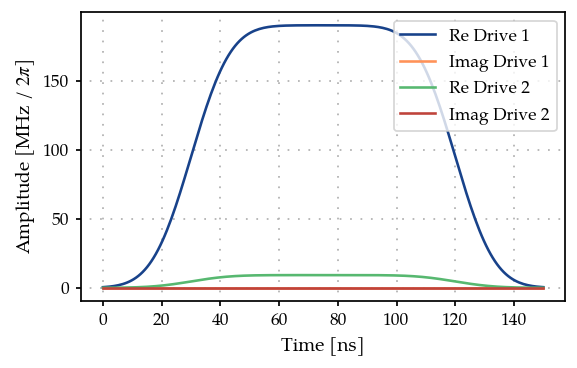
[Amp: 190 MHz x 2pi, t_up: 30 ns, t_down: 120 ns, ramp_time: 15 ns] [Amp: 9.18 MHz x 2pi, t_up: 30 ns, t_down: 120 ns, ramp_time: 15 ns]
(transmon2.frequency.get_value() - transmon1.frequency.get_value()) / (2 * np.pi)
Array([5.e+08], dtype=float64)
from plotting import plot_signal

tlist = np.linspace(0, t_final, 201)
fig, ax = plt.subplots(1, figsize=(5, 3))
plot_signal(tone1, tlist, ax, linestyle="-", label="Drive 1")
plot_signal(tone2, tlist, ax, linestyle="-", label="Drive 2")
ax.legend(loc=1, frameon=True)
plt.show()
We check the eigenvalues to make sure that there is no resonance while idling.
matrix = hamiltonian.get_value_at_timestep(0.0)
evals = np.linalg.eigvalsh(matrix)
print("Energies in GHz: ", np.round(evals / 1e6) / 1e3 / (2 * np.pi))
transitions = evals[1:] - evals[:-1]
print(
    "Transition energies in GHz: ",
    np.round(transitions / 1e3) / 1e6 / (2 * np.pi),
)
matrix
Energies in GHz:  [-0.          5.49864413  6.00109628 10.75823753 11.49735309 11.80404466 16.7555141  17.30475781 22.56021318]
Transition energies in GHz:  [5.49869649 0.50249417 4.75717547 0.73908102 0.3067312  4.95139654 0.54918068 5.25552493]
Array([[0.00000000e+00, 1.24401983e+05, 0.00000000e+00, 2.79215219e+06, 1.57079633e+08, 0.00000000e+00, 0.00000000e+00, 0.00000000e+00, 0.00000000e+00],
       [1.24401983e+05, 3.76991118e+10, 1.75930971e+05, 1.57079633e+08, 2.79215219e+06, 2.22144147e+08, 0.00000000e+00, 0.00000000e+00, 0.00000000e+00],
       [0.00000000e+00, 1.75930971e+05, 7.41415866e+10, 0.00000000e+00, 2.22144147e+08, 2.79215219e+06, 0.00000000e+00, 0.00000000e+00, 0.00000000e+00],
       [2.79215219e+06, 1.57079633e+08, 0.00000000e+00, 3.45575192e+10, 1.24401983e+05, 0.00000000e+00, 3.94869950e+06, 2.22144147e+08, 0.00000000e+00],
       [1.57079633e+08, 2.79215219e+06, 2.22144147e+08, 1.24401983e+05, 7.22566310e+10, 1.75930971e+05, 2.22144147e+08, 3.94869950e+06, 3.14159265e+08],
       [0.00000000e+00, 2.22144147e+08, 2.79215219e+06, 0.00000000e+00, 1.75930971e+05, 1.08699106e+11, 0.00000000e+00, 3.14159265e+08, 3.94869950e+06],
       [0.00000000e+00, 0.00000000e+00, 0.00000000e+00, 3.94869950e+06, 2.22144147e+08, 0.00000000e+00, 6.76070739e+10, 1.24401983e+05, 0.00000000e+00],
       [0.00000000e+00, 0.00000000e+00, 0.00000000e+00, 2.22144147e+08, 3.94869950e+06, 3.14159265e+08, 1.24401983e+05, 1.05306186e+11, 1.75930971e+05],
       [0.00000000e+00, 0.00000000e+00, 0.00000000e+00, 0.00000000e+00, 3.14159265e+08, 3.94869950e+06, 0.00000000e+00, 1.75930971e+05, 1.41748661e+11]], dtype=float64)
Computing the gate fidelity
We select a propagation method, piecewise constant exponentation, and configure CR as a target gate.
model = ClosedSystem(hamiltonian)
prop = ScipyExpmGOAT(model, resolution=100e9)

# We need to pad the operators with zeros so we introduce a helper zero matrix
dim = transmon1.dimension() * transmon2.dimension()
padding = ((0, dim - 4), (0, dim - 4))

pauli_x = np.array([[0.0, 1.0], [1.0, 0.0]])
pauli_y = np.array([[0.0, -1.0j], [1.0j, 0.0]])
pauli_z = np.array([[1.0, 0.0], [0.0, -1.0]])

pauli_ix = np.pad(np.kron(np.identity(2), pauli_x), pad_width=padding, mode="constant", constant_values=0.0)
pauli_iy = np.pad(np.kron(np.identity(2), pauli_y), pad_width=padding, mode="constant", constant_values=0.0)
pauli_iz = np.pad(np.kron(np.identity(2), pauli_z), pad_width=padding, mode="constant", constant_values=0.0)

pauli_zx = np.pad(
    np.exp(1j * np.pi / 4) * np.kron(pauli_z, pauli_x), pad_width=padding, mode="constant", constant_values=0.0
)

cr_gate = np.pad(
    np.array([[1.0, 0, 0, 0], [0, 1.0, 0, 0], [0, 0, 0, 1.0], [0, 0, 1.0, 0]]),
    pad_width=padding,
    mode="constant",
    constant_values=0.0,
)

cr_gate = pauli_zx @ cr_gate

times = np.array([0.0, t_final])

prop.set_initial_state(np.identity(transmon1.dimension() * transmon2.dimension()))
gate_fid = UnitaryFidelity(
    propagation=prop,
    gate=cr_gate,
)
gate_fid.measure(times)
0.13180213234859084
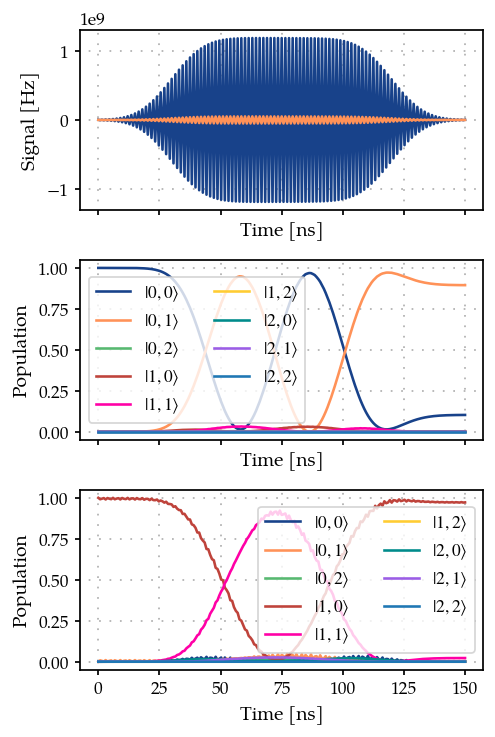
def plot_population(propagation: Propagation):
    """Plot the population from the Propagation object."""
    basis1 = [i for i in range(transmon1.dimension())]
    basis2 = [i for i in range(transmon2.dimension())]
    labels = [rf"$|{i},{j}\rangle$" for (i, j) in itertools.product(basis1, basis2)]

    signal1 = generator1.get_value(tlist)
    signal2 = generator2.get_value(tlist)
    states = propagation.propagate(tlist)

    _, ax = plt.subplots(3, figsize=(4, 6), sharex=True)
    ax[0].plot(tlist / 1e-9, signal1)
    ax[0].plot(tlist / 1e-9, signal2)
    ax[0].set_xlabel("Time [ns]")
    ax[0].set_ylabel("Signal [Hz]")
    ax[0].grid(True, linestyle=(1, (1, 5)), linewidth=1)

    ax[1].plot(tlist / 1e-9, np.abs(states)[:, :, 0] ** 2, label=labels)
    ax[1].set_xlabel("Time [ns]")
    ax[1].set_ylabel("Population")
    ax[1].legend(ncols=2)
    ax[1].grid(True, linestyle=(1, (1, 5)), linewidth=1)

    ax[2].plot(
        tlist / 1e-9,
        np.abs(states)[:, :, transmon2.dimension()] ** 2,
        label=labels,
    )
    ax[2].set_xlabel("Time [ns]")
    ax[2].set_ylabel("Population")
    ax[2].legend(ncols=2)
    ax[2].grid(True, linestyle=(1, (1, 5)), linewidth=1)

    plt.tight_layout()
    plt.show()


plot_population(prop)
def expecation_value(Op, states):
    """Get the expected value."""
    ex = []
    for state in states:
        ex.append(np.real(state.conj() @ Op @ state.T))
    return ex


def plot_pauli():
    """Plot the Pauli operators."""
    states = prop.propagate(tlist)
    sig1 = generator1.get_value(tlist)
    sig2 = generator2.get_value(tlist)

    fig, ax = plt.subplots(3, figsize=(4, 6), sharex=True)
    ax[0].plot(tlist / 1e-9, sig1)
    ax[0].plot(tlist / 1e-9, sig2)
    ax[0].set_ylabel("Field [MHz]")
    ax[0].grid(True, linestyle=(1, (1, 5)), linewidth=1)

    ax[1].plot(tlist / 1e-9, expecation_value(pauli_ix, states[:, :, 0]))
    ax[1].plot(tlist / 1e-9, expecation_value(pauli_iy, states[:, :, 0]))
    ax[1].plot(tlist / 1e-9, expecation_value(pauli_iz, states[:, :, 0]))
    ax[1].set_ylabel(r"$\langle 0, x|\hat\sigma_i|0, x\rangle$")
    ax[1].legend(["X", "Y", "Z"])
    ax[1].grid(True, linestyle=(1, (1, 5)), linewidth=1)

    ax[2].plot(tlist / 1e-9, expecation_value(pauli_ix, states[:, :, transmon2.dimension()]))
    ax[2].plot(tlist / 1e-9, expecation_value(pauli_iy, states[:, :, transmon2.dimension()]))
    ax[2].plot(tlist / 1e-9, expecation_value(pauli_iz, states[:, :, transmon2.dimension()]))
    ax[2].set_ylabel(r"$\langle 1, x|\hat\sigma_i|1, x\rangle$")
    ax[-1].set_xlabel("Time [ns]")
    ax[2].legend(["X", "Y", "Z"])
    ax[2].grid(True, linestyle=(1, (1, 5)), linewidth=1)

    return fig, ax


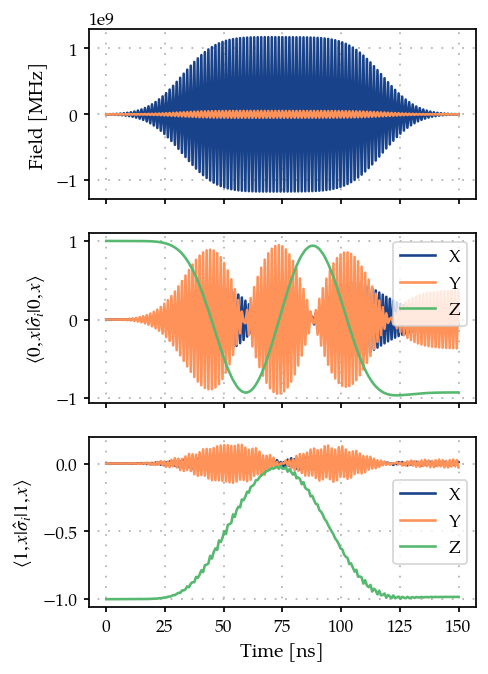
plot_pauli()
(<Figure size 500x750 with 3 Axes>,
 array([<Axes: ylabel='Field [MHz]'>, <Axes: ylabel='$\langle 0, x|\hat\sigma_i|0, x\rangle$'>, <Axes: xlabel='Time [ns]', ylabel='$\langle 1, x|\hat\sigma_i|1, x\rangle$'>], dtype=object))
Optimization
We define an optimizer and link our fidelity measure as a goal function. The only optimizable parameter is the frequency of transmon 1.
tone1.get_parameters()
[Amp: 190 MHz x 2pi, t_up: 30 ns, t_down: 120 ns, ramp_time: 15 ns]
optmap = OptimizationMap()
optmap.add(tone1)
print(optmap)

opt = ScipyOptimizerGradient(gate_fid, optimization_map=optmap)
opt.set_options({"ftol": 0.1})
==== <class 'paraqeet.signal.envelopes.FlatTopGaussianEnvelope'> ====
[Amp: 190 MHz x 2pi, t_up: 30 ns, t_down: 120 ns, ramp_time: 15 ns]
optmap
==== <class 'paraqeet.signal.envelopes.FlatTopGaussianEnvelope'> ====
[Amp: 190 MHz x 2pi, t_up: 30 ns, t_down: 120 ns, ramp_time: 15 ns]
opt.optimize(times)
{'status': 1, 'value': 0.8566635903399564, 'iterations': 4, 'message': 'CONVERGENCE: RELATIVE REDUCTION OF F <= FACTR*EPSMCH'}
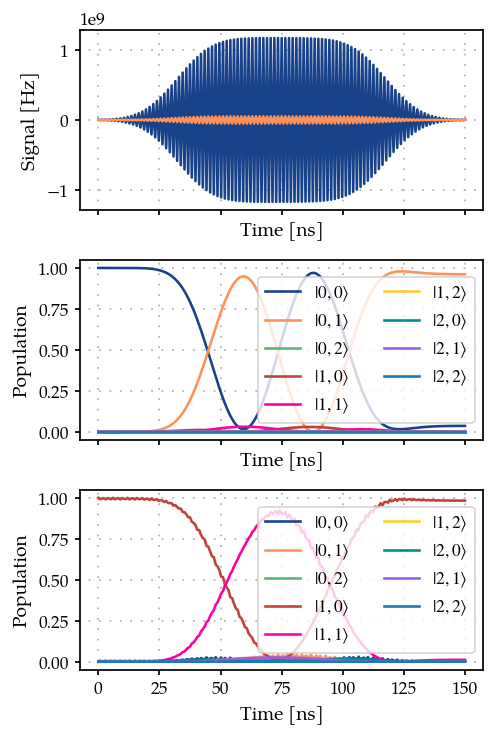
plot_population(prop)
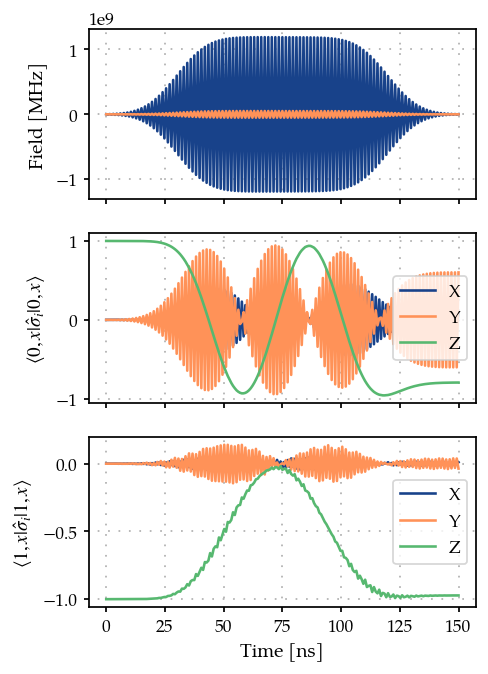
plot_pauli()
(<Figure size 500x750 with 3 Axes>,
 array([<Axes: ylabel='Field [MHz]'>, <Axes: ylabel='$\langle 0, x|\hat\sigma_i|0, x\rangle$'>, <Axes: xlabel='Time [ns]', ylabel='$\langle 1, x|\hat\sigma_i|1, x\rangle$'>], dtype=object))