
Gradient based dCRAB optimization of a single spin#
In this example, we solve the optimization task in the previous example by using the dCRAB (Rach et al., 2015) [3] (Müller et al., 2022) [14] optimization method. Here we implement a gradient based dCRAB algorithm by using the GOAToverGRAPE method, which combines GOAT (Machnes et al., 2018) [2] and GRAPE (Khaneja et al., 2005) [1] as a gradient-based variant of the GROUP method (Sørensen et al., 2018) [4].
1. Generate a PWC pulse shape#
import matplotlib.pyplot as plt
import numpy as np

from paraqeet.eom.schroedinger_equation import SchroedingerEquation
from paraqeet.hamiltonian.drive import Drive
from paraqeet.hamiltonian.qubit import QubitHamiltonian
from paraqeet.quantity import Quantity
from paraqeet.signal.envelopes import DCRABEnvelope
from paraqeet.signal.pwc_generator import PWCGenerator
from paraqeet.signal.signal import FlatTopGaussianFilter
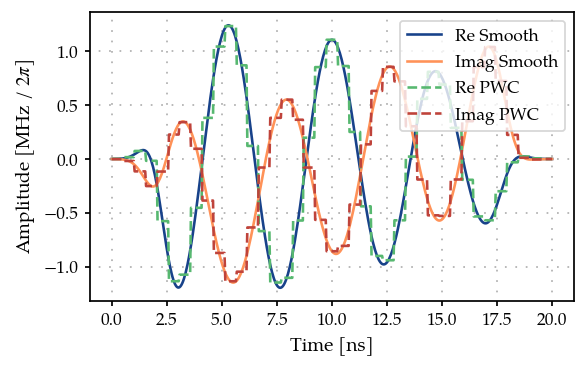
Similar to the previous case, let’s define the pulse generator, with the
envelope being the DCRABEnvelope. We use a FlatTopGaussianFilter
to ensure that the pulse always starts and ends at zero. Finally, to
obtain GRAPE gradients we pixelate the pulse using a PWCGenerator.
t_final = 20e-9
tlist = np.linspace(0, t_final, 40)
eps = 5 * np.pi * 1.0  # initial amplitude of the resonator (in MHz)
eps_max = 10 * eps  # maximum amplitude of the resonator (in MHz)

tone = DCRABEnvelope(
    num_components=2,
    max_frequency=5 * 2 * np.pi,
    amplitude=Quantity(eps * 1e6, -eps_max * 1e6, eps_max * 1e6, name="Amplitude"),
    t_final=Quantity(t_final, 1 / 2 * t_final, 2 * t_final, name="t_final"),
    seed=18537,
)
smooth_tone = FlatTopGaussianFilter(
    envelopes=tone, t_final=Quantity(t_final, 1 / 2 * t_final, 2 * t_final, name="t_final")
)

gen = PWCGenerator(envelopes=[smooth_tone], tlist=tlist, max_amplitude=np.sqrt(2) * eps_max * 1e6)

params = gen.get_parameters()
Here the DCRABEnvelope is defined with a seed to make sure that the
results obtained are reproducible.
from plotting import plot_signal

ts = np.linspace(0, t_final, 501)
fig, ax = plt.subplots(1, figsize=(5, 3))
plot_signal(smooth_tone, ts, ax, linestyle="-", label="Smooth")
plot_signal(gen, ts, ax, linestyle="--", label="PWC")
ax.legend(loc=1, frameon=True)
plt.show()
2. Define Hamiltonian in the rotating frame of drive#
As before we define a single spin in the rotating frame of the drive.
qubit_hamiltonian = QubitHamiltonian(frequency=Quantity(0.0, 0.0, 2 * np.pi * 1e6, unit="Hz"), drives=[])
drive = Drive(qubit_hamiltonian.sigma_minus, gen, add_hermitian=True)
qubit_hamiltonian.drives = [drive]
model = SchroedingerEquation(
    hamiltonian_func=qubit_hamiltonian.get_value,
    hamiltonian_gradient_func=qubit_hamiltonian.get_gradient,
)
And using GRAPE as the method to propagate and compute the gradients. The propagation \(dt\) has to be smaller than the \(\Delta t\) of the time grid used for discretization. In this case \(\Delta t = 0.5\) ns, so we choose the propagation resolution to be > 2e9.
from paraqeet.measurement.state_transfer_fidelity import StateTransferFidelityGRAPE
from paraqeet.measurement.utils import overlap_state_vector
from paraqeet.propagation import GRAPE, Expm
from paraqeet.propagation.utils import grape_operator_sandwich_function_closed

init = np.array([[1.0], [0.0]])  # |0>
target = np.array([[0.0], [1.0]])  # |1>

propagation = Expm(eom_func=model.get_value, resolution=3e9, initial_state=init)
prop = GRAPE(
    propagation,
    eom_gradient_func=model.get_gradient,
    target_state=target,
    operator_sandwich_function=grape_operator_sandwich_function_closed,
    order=3
)

zeroone = StateTransferFidelityGRAPE(
    propagation_func=prop.get_value,
    propagation_gradient_func=prop.get_gradient,
    target_state=target,
    overlap=overlap_state_vector,
)
from plotting import plot_signal_and_dynamics

ts = np.linspace(0.0, t_final, 101)
plot_signal_and_dynamics(gen, prop, ts, state_labels=[r"$|0\rangle$", r"$|1\rangle$"])
array([<Axes: ylabel='Amplitude n[MHz / $2\pi$]'>,
       <Axes: xlabel='Time [ns]', ylabel='Population'>], dtype=object)

3. Optimization#
Finally, we define the DCRABOptimizerGradient that takes the
GOATOverGRAPE fidelity to chain together the GRAPE gradients to
compute the gradient wrt the dCRAB envelope
params = tone.get_parameters()
params
[Amplitude: 1.57e+07,
 t_final: 2e-08,
 CRAB Re coefficient 0: 0.801,
 CRAB Re coefficient 1: -0.707,
 CRAB Re frequency 0: 4 Hz x 2pi,
 CRAB Re frequency 1: 4.51 Hz x 2pi,
 CRAB Re Phase 0: -475 mrad,
 CRAB Re Phase 1: 2.01 rad,
 CRAB Im coefficient 0: -0.419,
 CRAB Im coefficient 1: 0.72,
 CRAB Im frequency 0: 472 mHz x 2pi,
 CRAB Im frequency 1: 4.27 Hz x 2pi,
 CRAB Im Phase 0: -145 mrad,
 CRAB Im Phase 1: 1.99 rad]
Here we add the parameters from the DCRABEnvelope to the optmap
(except the t_final to keep the simulation time constant)
import tempfile

from paraqeet.file_logger import FileLogger
from paraqeet.measurement.goat_over_grape import GOATOverGRAPE
from paraqeet.optimization_map import OptimizationMap
from paraqeet.optimizers.dcrab_optimizer_gradient import DCRABOptimizerGradient

temp_dir = tempfile.TemporaryDirectory(suffix="pq")  # Ends in 'pq' to prevent _ at the end

file_logger = FileLogger(temp_dir.name)

optmap = OptimizationMap()
optmap.add(tone, [params[0]] + params[2:])
optmap.register_params_with_optimizables()

goat = GOATOverGRAPE(zeroone, gen, propagation.resolution)
opt_grad = DCRABOptimizerGradient(
    measure_and_gradient_func=goat.get_value_and_gradient,
    optimization_map=optmap,
    super_iteration_every=150,
    max_super_iteration_num=5,
    print_every_iteration_num=10,
    super_iteration_tol=1e-9,
    seed=19573,
)
opt_grad.logger = file_logger
The optmap in this case contains the pulse amplitude and the Fourier
coefficients for the optimization.
optmap
==== <class 'paraqeet.signal.envelopes.DCRABEnvelope'> ====
[Amplitude: 1.57e+07, CRAB Re coefficient 0: 0.801, CRAB Re coefficient 1: -0.707, CRAB Re frequency 0: 4 Hz x 2pi, CRAB Re frequency 1: 4.51 Hz x 2pi, CRAB Re Phase 0: -475 mrad, CRAB Re Phase 1: 2.01 rad, CRAB Im coefficient 0: -0.419, CRAB Im coefficient 1: 0.72, CRAB Im frequency 0: 472 mHz x 2pi, CRAB Im frequency 1: 4.27 Hz x 2pi, CRAB Im Phase 0: -145 mrad, CRAB Im Phase 1: 1.99 rad]
opt_grad.optimize(np.array([0.0, t_final]))
Iteration number = 0 Infidelity = 9.999e-01
Iteration number = 10 Infidelity = 2.753e-03
==== Decrease in infidelity less than 1e-09 ====
==== Starting super-iteration 1 ====
* Current lowest infidelity =  2.071e-11
* Current no. of parameters = 25
Iteration number = 20 Infidelity = 4.878e-02
Iteration number = 30 Infidelity = 2.294e-05
Setting parameters to the best values.
Stopping the optimization or backtracking to previous best fidelity. Going to step with 13 parameters.
{'status': 1, 'value': 2.071320892582662e-11, 'iterations': 33, 'message': 'CONVERGENCE: RELATIVE REDUCTION OF F <= FACTR*EPSMCH'}
As the parameters are added with random values, the optimization may not succeed sometimes. If it does not reach a low value, restart the optimization. Here, we have chosen a seed that converges to the target fidelity.
opt_grad.set_parameters(opt_grad.best_params)
plot_signal_and_dynamics(gen, prop, ts)
array([<Axes: ylabel='Amplitude n[MHz / $2\pi$]'>,
       <Axes: xlabel='Time [ns]', ylabel='Population'>], dtype=object)

from plotting import plot_infidelity_vs_evaluation_from_logs

plot_infidelity_vs_evaluation_from_logs(log_path=temp_dir.name + "/opt.log", label="GOAT over GRAPE")
<Axes: xlabel='Evaluation number', ylabel='Infidelity'>

temp_dir.cleanup()
References#
(Khaneja et al., 2005) N. Khaneja et al., “Optimal control of coupled spin dynamics: design of NMR pulse sequences by gradient ascent algorithms,” Journal of Magnetic Resonance 172, 296–305 (2005).
(Machnes et al., 2018) S. Machnes et al., “Tunable, flexible, and efficient optimization of control pulses for practical qubits,” Physical Review Letters 120, 150401 (2018).
(Sørensen et al., 2018) J. J. W. H. Sørensen et al., “Quantum optimal control in a chopped basis: Applications in control of Bose-Einstein condensates,” Physical Review A 98, 022119 (2018).
(Rach et al., 2015) N. Rach et al., “Dressing the chopped-random-basis optimization: A bandwidth-limited access to the trap-free landscape,” Physical Review A 92, 062343 (2015).
(Müller et al., 2022) M. M. Müller et al., “One decade of quantum optimal control in the chopped random basis,” Reports on Progress in Physics 85, 076001 (2022).