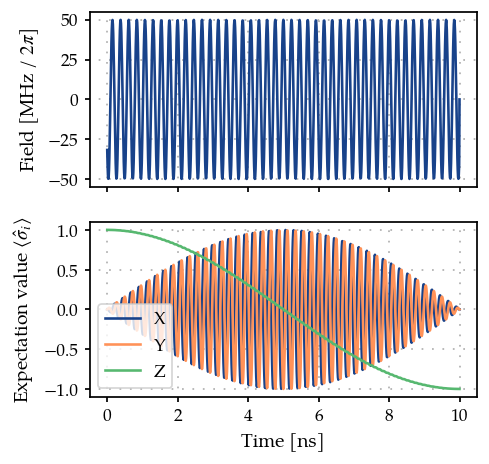
Single spin Part 2: Gradient descent gate optimization#
In this notebook, we show how to use ParaQeet to optimize a
single-qubit gate, specifically an \(X\)-gate.
import matplotlib.pyplot as plt
import numpy as np

from paraqeet.measurement.unitary_fidelity import UnitaryFidelity
from paraqeet.model.closed_system import ClosedSystem
from paraqeet.model.drive_operator import DriveOperator
from paraqeet.model.qubit import Qubit
from paraqeet.optimization_map import OptimizationMap
from paraqeet.optimizers.scipy_optimizer import ScipyOptimizer
from paraqeet.optimizers.scipy_optimizer_gradient import ScipyOptimizerGradient
from paraqeet.propagation.scipy_expm_goat import ScipyExpmGOAT
from paraqeet.quantity import Quantity
from paraqeet.signal.envelopes import ConstantEnvelope
from paraqeet.signal.iq_mixer import IQMixer
System Setup#
We first set up the qubit system we want to control. We set the qubit frequency \(\omega_q / 2 \pi\) to be \(4.327884\) GHz and define the Hamiltonian as
where \(\Omega(t)\) will be supplied by the generator.
freq = 4.327884e9 * 2 * np.pi

# drive = DriveOperator(gen, is_longitudinal=False)
controlled_qubit = Qubit(
    frequency=Quantity(
        freq,
        min_value=freq / 4,
        max_value=freq,
        unit="Hz",
        name="Qubit frequency",
    ),
    drives=[],
)
For signal generation, we define a simple cosine shaped tone generator \(A \cos(\omega t)\)
t_simu = 10e-9
tone = ConstantEnvelope()
# In this notebook we set the parameter t_final equal to the simulation
# time, but it is not strictly necessary as long as t_final is larger
# than t_simu (see the notebook 02A_Single_qubit_state_preparation.ipynb)
tone.t_final.set_value(t_simu)
gen = IQMixer(envelopes=[tone])
We can inspect the parameters with
params_tone = tone.get_parameters()
print(params_tone)
params_gen = gen.get_parameters()
print(params_gen)
[Amplitude: 24.7 MHz x 2pi, t_final: 10 ns]
[Amplitude: 24.7 MHz x 2pi, t_final: 10 ns, lo_freq: 4.8 GHz x 2pi, Phase: 0 rad]
In this notebook, we would like to optimize the amplitude Amplitude
and frequency lo_freq if the drive. We add a drive on the qubit.
drive = DriveOperator(gen, is_longitudinal=False)
controlled_qubit.drives = [drive]
model = ClosedSystem(controlled_qubit)
In this notebook, we would like to optimize the amplitude Amplitude
and frequency lo_freq if the drive. We add a drive on the qubit.
drive = DriveOperator(gen, is_longitudinal=False)
controlled_qubit.drives = [drive]
model = ClosedSystem(controlled_qubit)
Textbook values for implementing an \(X\) rotation on this system at a time \(T\) would be \(\omega=\omega_q\) and \(A=\pi/T\). We use some offset from these values as initial guess to demonstrate the optimization procedure.
params_gen[0].set_value(0.5 * np.pi / t_simu)
params_gen[2].set_value(1.01 * freq)
We select a propagation method, piecewise constant exponentiation, and configure an \(X\)-gate as a target gate. Also we initialize the identity at time \(0\).
prop = ScipyExpmGOAT(model, resolution=500e9)
times = np.array([0.0, t_simu])

pauli_x = np.array([[0.0, 1.0], [1.0, 0.0]])
pauli_y = np.array([[0.0, -1.0j], [1.0j, 0.0]])
pauli_z = np.array([[1.0, 0.0], [0.0, -1.0]])

prop.set_initial_state(np.identity(2))
gate_fid = UnitaryFidelity(
    propagation=prop,
    gate=pauli_x,
)
from plotting import plot_signal_and_dynamics

ts = np.linspace(0.0, t_simu, 501)
plot_signal_and_dynamics(gen, prop, ts, state_labels=[r"$|0\rangle$", r"$|1\rangle$"]);
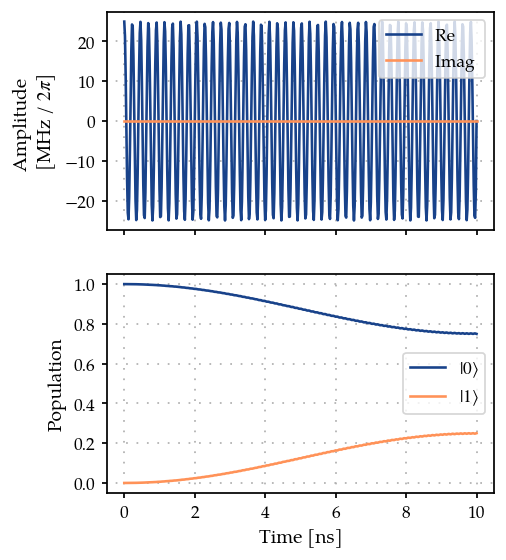
As expected, we get a partial transfer and a low fidelity.
print(f"Gate fidelity: {gate_fid.measure(times)}")
Gate fidelity: 0.09555411208408474
We define an optimizer and link our fidelity measure as a goal function and the parameters of the cosine tone and optimize just amplitude and frequency, as in the state transfer example.
optmap = OptimizationMap()
optmap.add(gen, [params_gen[0], params_gen[2]])
opt = ScipyOptimizerGradient(gate_fid, optimization_map=optmap)
opt.optimize(times)
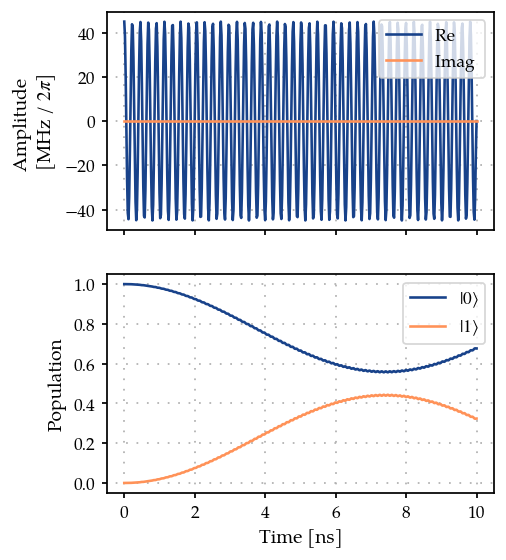
{'status': 1, 'value': 0.8037201693294315, 'iterations': 17, 'message': 'CONVERGENCE: NORM OF PROJECTED GRADIENT <= PGTOL'}
plot_signal_and_dynamics(gen, prop, ts, state_labels=[r"$|0\rangle$", r"$|1\rangle$"]);
Dynamics of Pauli operators#
Here, we end up with an unsatisfactory result. For optimizing gate fidelities, looking at state populations does not give enough information to identify the problem.
def expecation_value(op, states):
    """Get the expectation value across states."""
    ex = []
    for state in states:
        ex.append(np.real(state.conj() @ op @ state.T))
    return ex
def plot_pauli():
    """Plot the Pauli operators."""
    ts = np.linspace(0, t_simu, 1001)
    states = prop.propagate(ts)
    sig = gen.get_value(ts) / 1e6 / (2 * np.pi)

    fig, ax = plt.subplots(2, figsize=(4, 4), sharex=True)
    ax[0].plot(ts / 1e-9, sig)
    ax[0].set_ylabel(r"Field [MHz / $2\pi$]")
    ax[0].grid(True, linestyle=(1, (1, 5)), linewidth=1)

    ax[1].plot(ts / 1e-9, expecation_value(pauli_x, states[:, :, 0]))
    ax[1].plot(ts / 1e-9, expecation_value(pauli_y, states[:, :, 0]))
    ax[1].plot(ts / 1e-9, expecation_value(pauli_z, states[:, :, 0]))
    ax[1].set_ylabel(r"Expectation value $\langle\hat\sigma_i\rangle$")
    ax[1].grid(True, linestyle=(1, (1, 5)), linewidth=1)

    ax[-1].set_xlabel("Time [ns]")
    ax[1].legend(["X", "Y", "Z"])
    return fig, ax


plot_pauli()
(<Figure size 500x500 with 2 Axes>,
 array([<Axes: ylabel='Field [MHz / $2\pi$]'>,
        <Axes: xlabel='Time [ns]', ylabel='Expectation value $\langle\hat\sigma_i\rangle$'>],
       dtype=object))
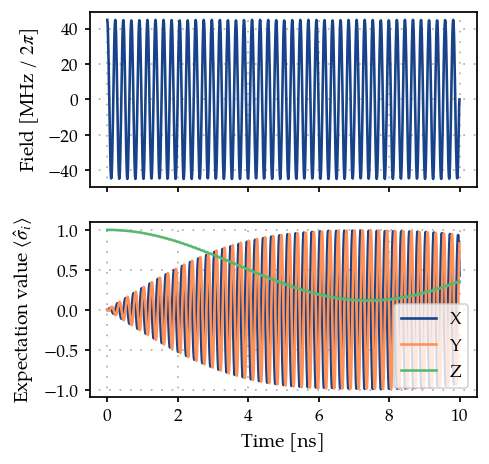
Instead, we look at the expectation values of the three Pauli operators and observe that the qubit is rotating at its eigenfrequency along the Z-axis. We can mitigate this problem by allowing the rotation axis of our drive to shift and include the phase parameter in the optimization.
optmap = OptimizationMap()
optmap.add(tone, [params_gen[0], params_gen[2], params_gen[3]])
opt = ScipyOptimizer(gate_fid, optimization_map=optmap)
params_gen[0].set_value(0.5 * np.pi / t_simu)
params_gen[2].set_value(1.01 * freq)
opt.optimize(times)
{'status': 1, 'value': 1.0475176281943277e-11, 'iterations': 108, 'message': 'CONVERGENCE: RELATIVE REDUCTION OF F <= FACTR*EPSMCH'}
plot_pauli()
(<Figure size 500x500 with 2 Axes>,
 array([<Axes: ylabel='Field [MHz / $2\pi$]'>,
        <Axes: xlabel='Time [ns]', ylabel='Expectation value $\langle\hat\sigma_i\rangle$'>],
       dtype=object))